How games for adults can be used with children too, and how children can learn through play…
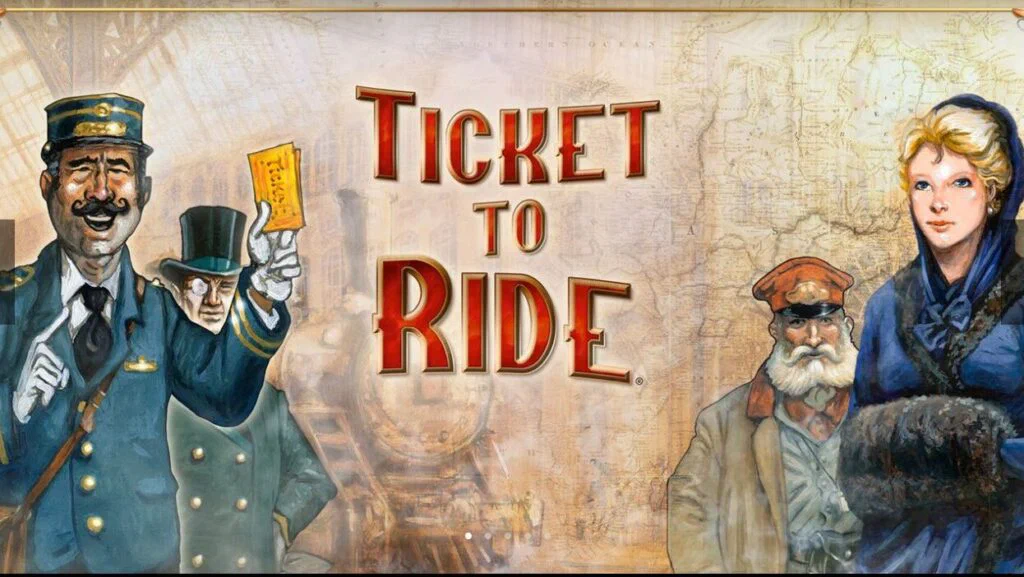
This year, I had resolved to bring more play back into my life. That sounds odd, because with a three-year-old and a five-year-old I spend a large part of my time on the floor among racing cars, dolls and puzzle pieces. But I have to admit that I don’t always throw myself into playing with energy and enthusiasm, especially not when my son wakes me at 6 in the morning and immediately demands a round of “Connect Four”. It was also him who discovered the game “Ticket to Ride” on my tablet. The aim is to build railway connections between different cities. There are various maps on which you can build routes, e.g. across the USA, Europe or China. At the start, you choose the train routes you want to build. The routes are made up of sections in different colours, e.g. you need 2 blue, 4 green and 3 yellow train cards to connect two cities. You play either against a real opponent or against the computer.
So, what’s educationally worthwhile about that? I asked myself the same thing when my 5-year-old son kept asking me whether we could play the game together. I said no many times, because I thought he had plenty of games for his age. But as he is a big railway fan, he didn’t let up, and one morning, when he had once again woken me shortly after six, my willpower wasn’t awake yet and I said yes.
To my amazement, I discovered that, for one thing, Ragnar didn’t get bored, even though at first he could only watch while I built the routes, and for another, that you really can use the game to train various skills:
Generally speaking, most games require you to wait until it’s your turn. Here a child has to learn to hold back (the technical term for this is inhibition, which is part of the executive functions that are important for learning).
Turn-taking, i.e. taking turns, which is also needed in conversations, is required here (if you want to read more about turn-taking in early language development, have a look at the following blog post).
You have to remember rules and procedures. For example, you may only draw two train cards per turn. If you want a wild card (a locomotive), you don’t get a second card. You can either build or draw new cards. So a child needs to understand rules and at the same time use their working memory to keep all these rules and procedures in mind while planning the next steps (read more about working memory and why it is closely linked to language development here).
Children practise recognising colours and counting track sections. There is adding and subtracting to do (we have 35 track pieces in total, we needed ten pieces for the first route, so we have 25 pieces left for the second route, and so on).
Problem-solving strategies have to be applied, and you have to think ahead about which steps make sense next (e.g. which cities can be connected most cleverly so that as few track pieces as possible are needed?).
In the case of “Ticket to Ride”, you also learn a great deal about the geography of different continents and countries.
So what am I trying to tell you with all this?
- Playing is just brilliant, because you can learn so much along the way without even noticing.
- The learning happens all by itself, without working through a timetable or pursuing specific learning goals.
- Many games, even if at first you don’t think they’re suitable, can be used with children (it’s often up to you which rules you follow and how you can simplify the game if it’s still too hard for the child. The same goes for books. If you’d like to know how you can use The Very Hungry Caterpillar from a very young age right up to school age, you can read about it here).
Well then, I certainly hope the next lockdown isn’t just around the corner, but go ahead and play lots during your family time – no matter what. The main thing is that it’s fun! Because fun and motivation are what make learning possible in the first place. Life is serious enough, so you might as well give joy a little more free rein.
Take care,
Blanca
References
Link to the app in the App Store and on Google Play
Featured image from the developer’s website.